Inside Space Expo Noordwijk: Stories Behind Space Technology

A Soyuz capsule still bearing the marks of atmospheric re-entry. Original control consoles once used during Ariane 4 launches. A small piece of rock brought back from the Moon. At Space Expo in Noordwijk, objects tell the history of space exploration, often with stories as interesting as the missions themselves.
In September 2026, while attending ESA Industry Space Days in the Netherlands, we also visited Space Expo, the official visitor centre of ESA’s European Space Research and Technology Centre (ESTEC).
The museum offers a different perspective on the space sector. Instead of discussing upcoming programmes, new technologies and business opportunities, visitors can examine the equipment, spacecraft and personal belongings that document decades of exploration.
Some exhibits were particularly relevant to our work at Iterative Engineering. Others caught our attention because of an unusual detail or an unexpected connection to space history. And one of them brought back a memory from 37 years ago.
Apollo 11, a Moon Rock and a Memory from 1989
One of Space Expo’s most recognisable exhibits recreates the Apollo 11 Moon landing. A full-scale model of the Eagle lunar module, accompanied by figures representing Neil Armstrong and Buzz Aldrin, brings visitors close to the spacecraft that landed on the Moon on 20 July 1969.
The model reveals details that are less obvious in historical photographs. Among them is the distinctive, crinkled gold-coloured material covering parts of the lunar module. Similar layers of specialised thermal insulation protected equipment on the original spacecraft from extreme temperature variations.
Nearby, Space Expo displays something much smaller but no less remarkable: a genuine Moon rock.
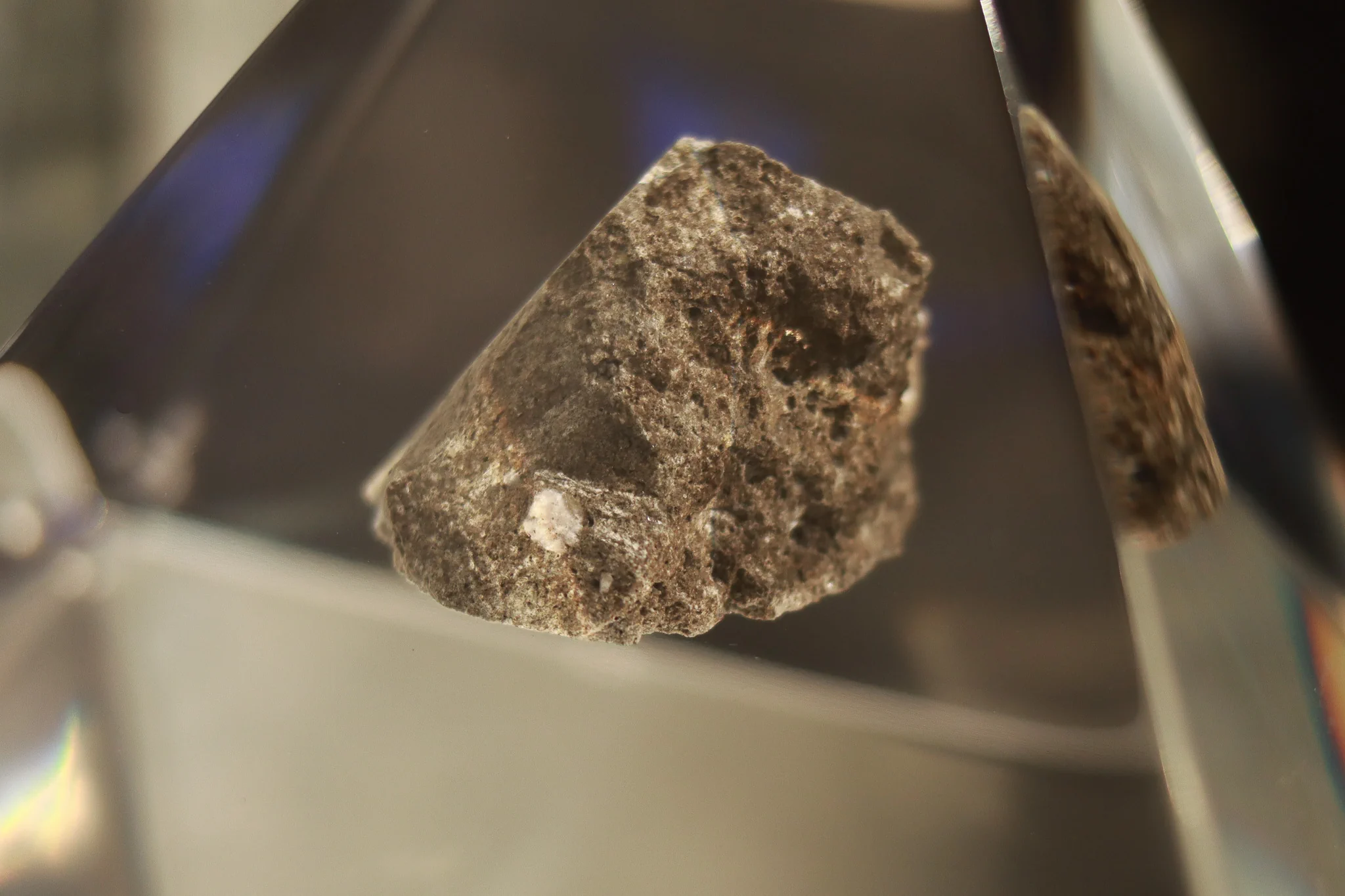
A genuine Moon rock on display at Space Expo in Noordwijk. This small lunar sample, presented in a protective case, offers visitors a rare opportunity to see material brought back from the Moon.
Photo: Paweł Grzywocz / Iterative Engineering.
For Tomasz, our Content Specialist, this exhibit brought back a rather unexpected memory.
A Moon Rock, a Diary and a 37-Year-Old Memory
When I saw the Moon rock at Space Expo, I immediately thought of my first trip to the Netherlands in July 1989. I was there on a youth exchange, and I remembered visiting a museum where I had seen what I believed was a genuine rock from the Moon.
For a moment, I wondered whether I had somehow returned to the same museum.
Fortunately, I still have the diary I kept during that trip. One entry reads (translated from Polish):
“We then went to Giethoorn, the ‘Dutch Venice’, a town on the water. After visiting an excellent gemstone museum, we watched a film about the first Moon landing. We also saw a rock from the Moon.”
That settled the question of where I had been. The museum was in Giethoorn, probably De Oude Aarde, a museum of minerals and gemstones. Space Expo could not have been the same place anyway, as it only opened in 1990.
But my search led me to a rather amusing discovery.
In October 1969, during the Apollo 11 astronauts’ visit to the Netherlands, former Dutch Prime Minister Willem Drees received a supposed Moon rock from the American ambassador. The object later became part of the Rijksmuseum collection in Amsterdam.
For decades, its lunar origin went largely unquestioned. Then, in 2009, scientific examination revealed that the alleged Moon rock was actually a piece of petrified wood from Earth.
There is no evidence connecting that object with the rock I saw in Giethoorn in 1989. To this day, I don’t know exactly what was displayed at the museum during our visit.
At least this time, I can be sure the rock really came from the Moon.
Tomasz / Iterative Engineering
The story of the Rijksmuseum’s mistaken lunar sample is documented in its official collection catalogue.
Space Expo’s lunar exhibition also connects the Apollo era with more recent exploration. Its Artemis II: Back to the Moon! exhibition examines the programme that sent four astronauts around the Moon in April 2026.
Europe played a significant role in that mission. ESA’s European Service Module provided Orion with propulsion, electrical power, thermal control and essential supplies for the crew.
Ariane: From Rocket Engines to Launch Operations
European launch vehicles are well represented at Space Expo, not only through scale models but also through original hardware.
Among the exhibits is an engine assembly from Ariane 1, featuring the Viking engines used in the launcher’s first stage. Seen up close, the assembly is a complex arrangement of pipes, valves and combustion chambers, with engineering details that are easy to overlook in photographs of a complete rocket.
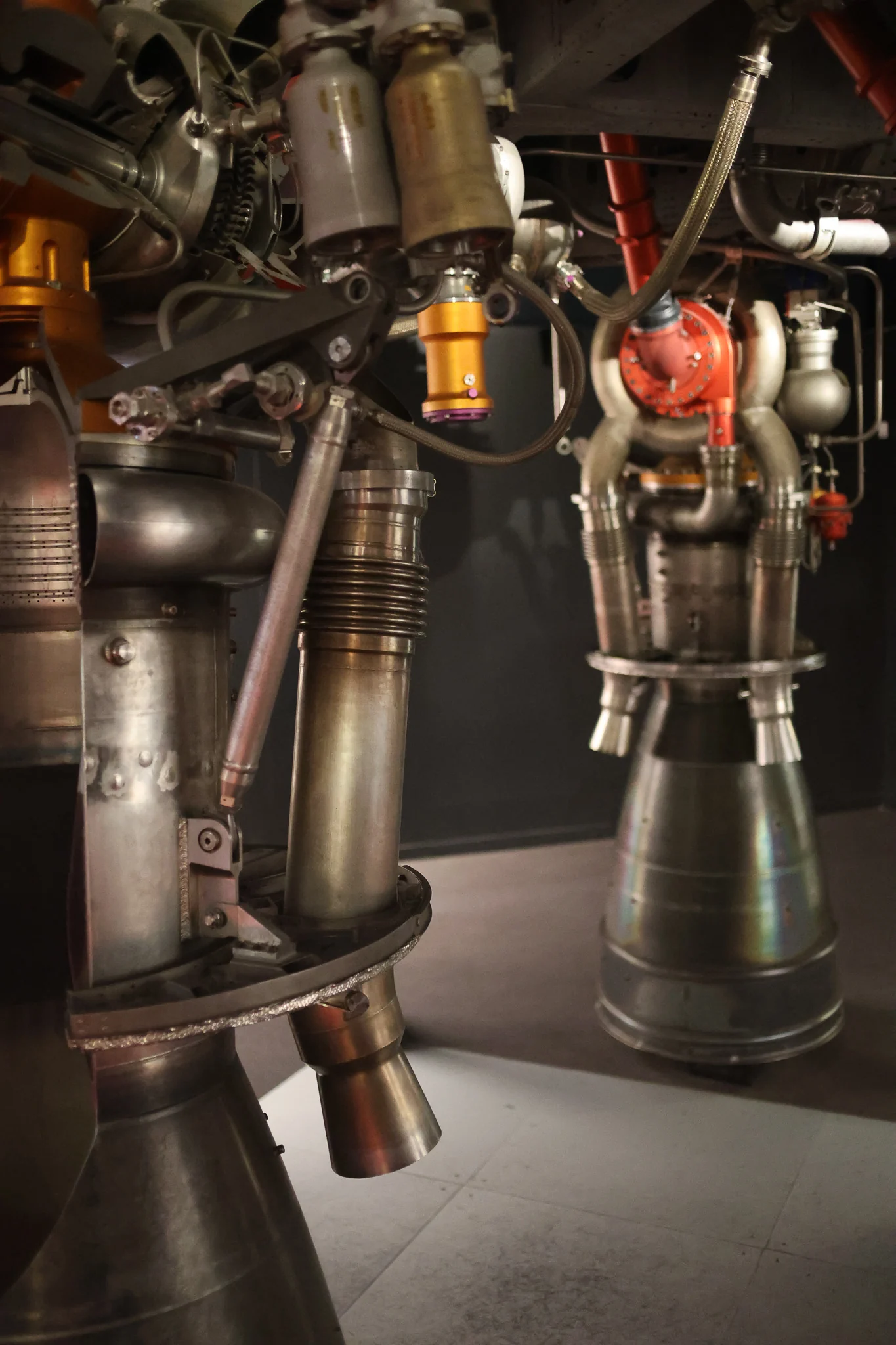
Original Viking rocket engine assembly from Ariane 1, Europe’s first Ariane launcher. Its intricate arrangement of pipes, valves and engine components illustrates the engineering behind the rocket that made its maiden flight from Kourou on 24 December 1979.
Photo: Tomasz Pac / Iterative Engineering.
The first Ariane rocket launched from Kourou, French Guiana, on 24 December 1979. It marked an important step in Europe’s efforts to develop its own access to space.
Successive generations of Ariane were designed to carry increasingly demanding payloads. Ariane 4, introduced in 1988, became particularly successful, completing 113 launches before its retirement in 2003.
Yet one of the most interesting exhibits for us was not an engine or a rocket structure. It was a pair of original Ariane 4 launch control consoles.
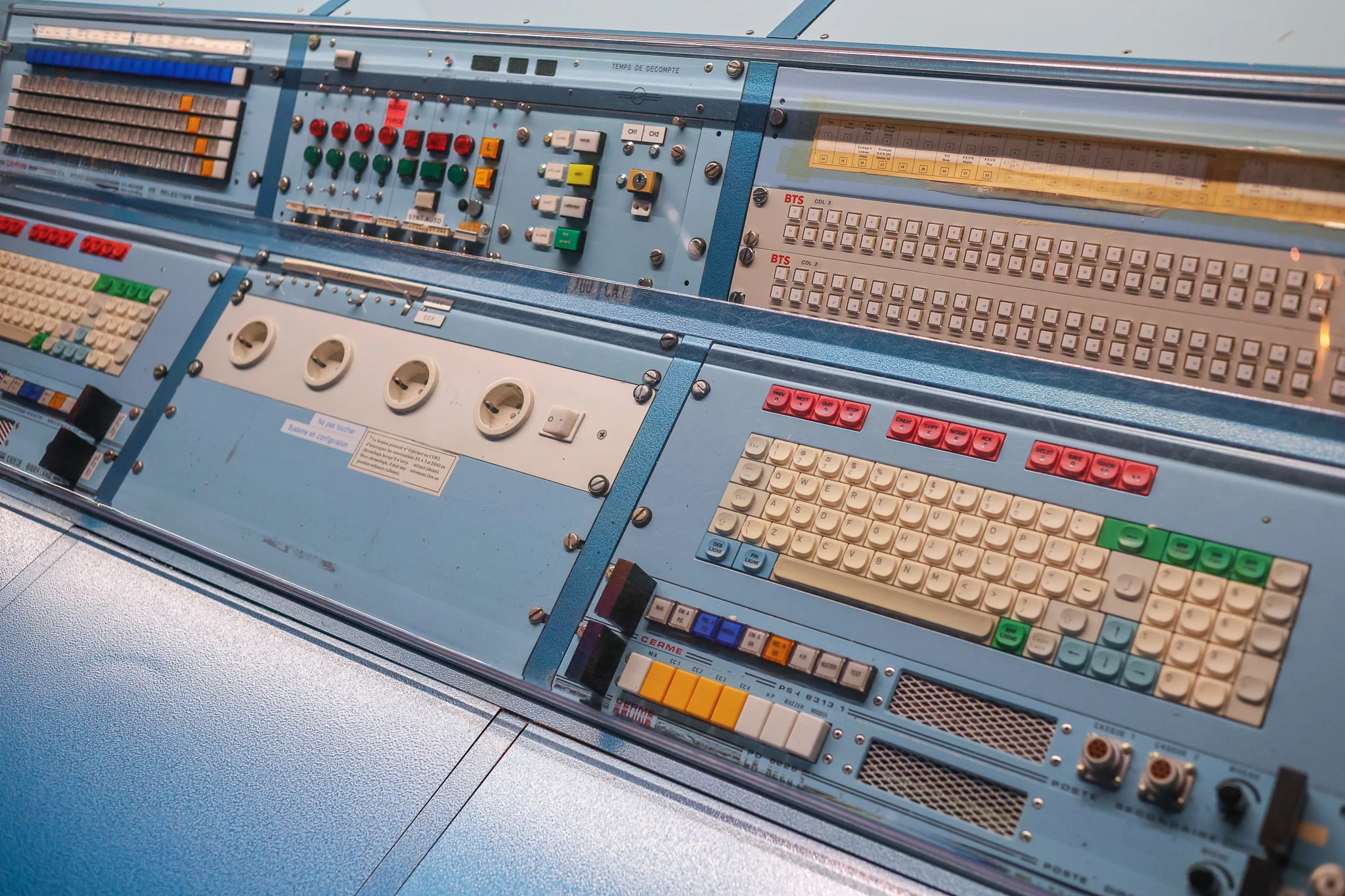
One of the original Ariane 4 launch control consoles used at Europe’s Spaceport in Kourou, French Guiana, between 1988 and 2003. These operator interfaces formed part of the ground infrastructure supporting the launch of European rockets.
Photo: Tomasz Pac / Iterative Engineering.
According to the museum’s description, these consoles were used during Ariane 4 launches from Kourou between 1988 and 2003. One was used to control the rocket’s third stage, while the other served as the Director of Operations’ console.
Rows of switches, indicator lights, buttons and keyboards offer a glimpse of the operational interfaces used before today’s graphical control systems became widespread.
Of course, launching a rocket involved much more than operating these consoles. They formed part of a larger ground infrastructure, with monitoring systems, dedicated equipment, procedures and teams responsible for different stages of launch preparation.
This exhibit had particular relevance to our work.
Iterative Engineering has been involved in developing LaunchReady, a software solution supporting the coordination of payload preparation activities and service requests during launch campaigns at Europe’s Spaceport in Kourou.
LaunchReady is not a rocket control system. It addresses a different part of spaceport operations, but the historical Ariane 4 consoles provide a useful reminder of the complex ground-based processes behind every launch.
We previously described this work in our article LaunchReady – On-Site Simulation.
Soyuz and the ISS: Space Technology Designed Around People
One of Space Expo’s most valuable exhibits is the original Soyuz TMA-03M descent module.
On 1 July 2012, this capsule returned ESA astronaut André Kuipers, Russian cosmonaut Oleg Kononenko and NASA astronaut Donald Pettit to Earth after a long-duration mission aboard the International Space Station.
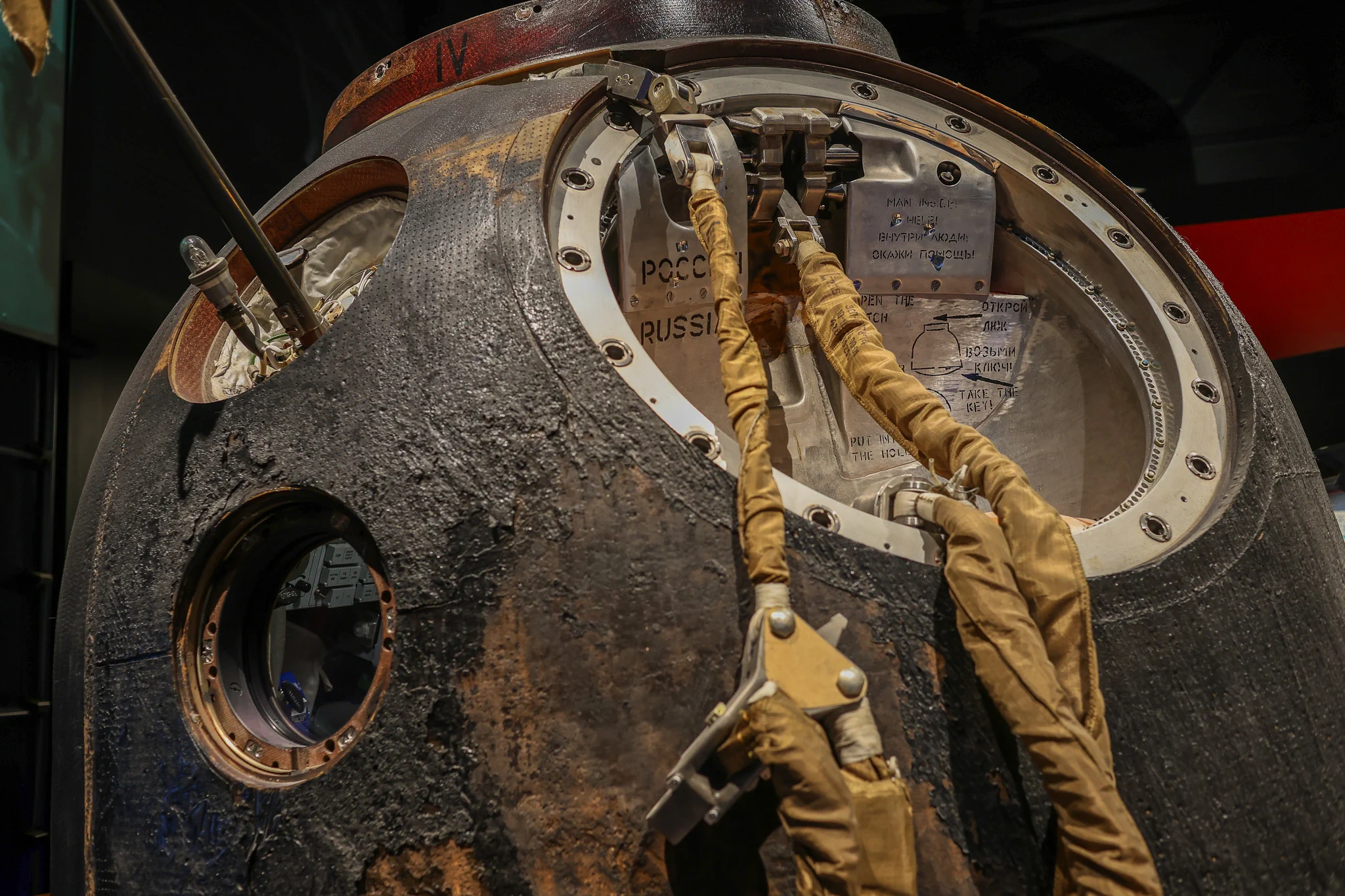
The original Soyuz TMA-03M descent capsule, with visible marks of atmospheric re-entry. On 1 July 2012, it returned ESA astronaut André Kuipers, Russian cosmonaut Oleg Kononenko and NASA astronaut Donald Pettit to Earth after 193 days in space.
Photo: Tomasz Pac / Iterative Engineering.
Its exterior still bears the marks of atmospheric re-entry. Visitors can also look through the open hatch and see just how limited the available space was.
The Soyuz spacecraft originated in the Soviet space programme of the 1960s. Its design has undergone numerous upgrades, but the basic architecture has remained recognisable for decades.
Inside the descent module, three crew members must share a remarkably small space with flight controls, life-support equipment and systems required for re-entry and landing.
Space Expo also has a Soyuz simulator that offers visitors a closer look at the spacecraft’s interior. Paweł Grzywocz, CTO of Iterative Engineering, took the opportunity to try it.
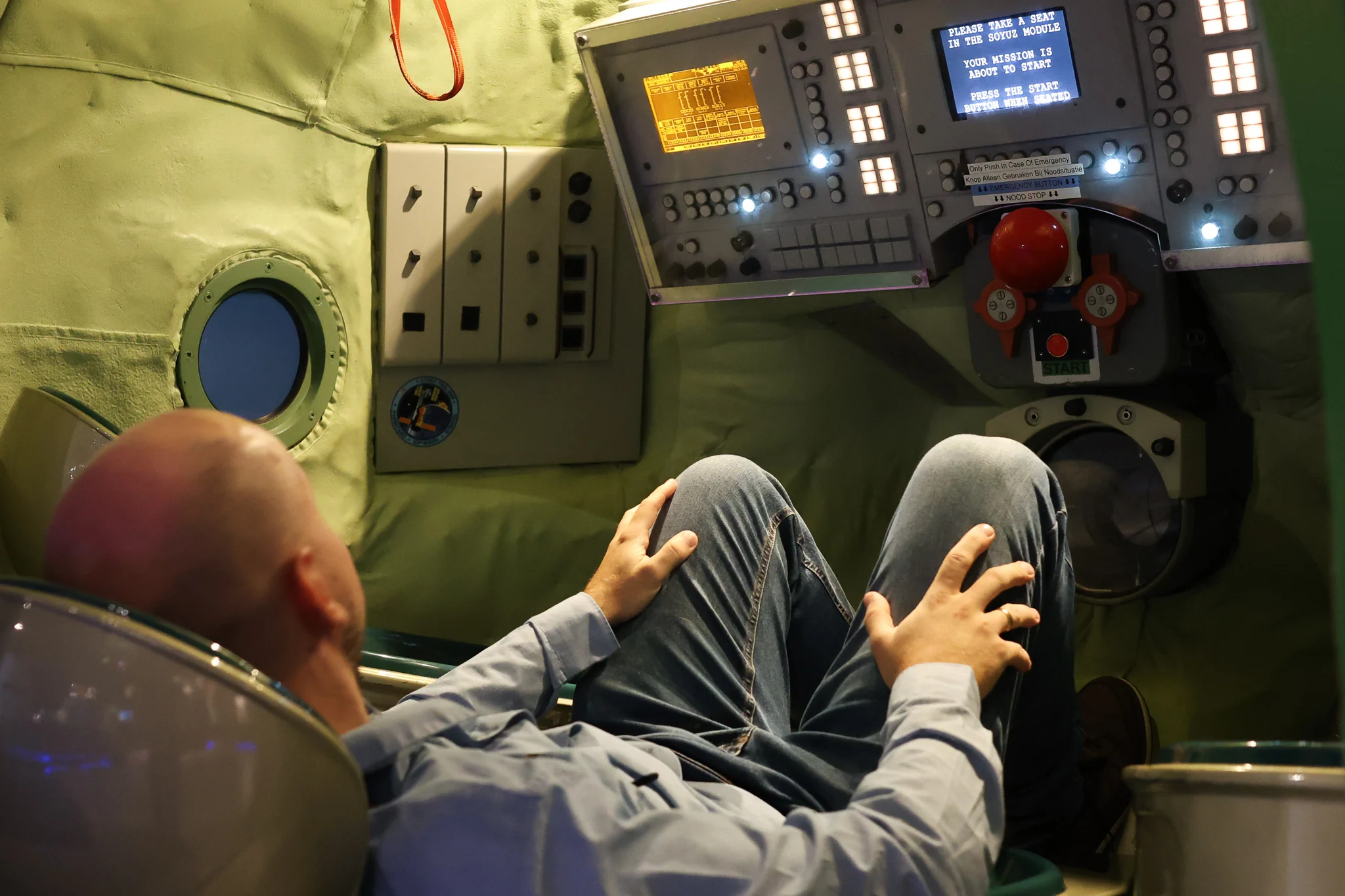
Paweł Grzywocz, CTO of Iterative Engineering, inside a Soyuz spacecraft simulator at Space Expo. The reclining seat and surrounding instrument panels offer a glimpse of the confined working environment experienced by crews during their journey to and from orbit.
Photo: Tomasz Pac / Iterative Engineering.
Even this museum recreation helps convey the constraints of crewed spaceflight. The astronaut sits in a semi-reclined position, surrounded by instrument panels, padding, and equipment. In a real spacecraft, almost every available surface serves a purpose.
Life becomes different again once astronauts reach orbit.
Space Expo features full-scale mock-ups of modules from the International Space Station, allowing visitors to explore how living and working spaces are organised in microgravity.
During our visit, we even attempted to recreate the familiar sight of astronauts floating inside an orbital module. Without actual microgravity, the effect was necessarily short-lived.
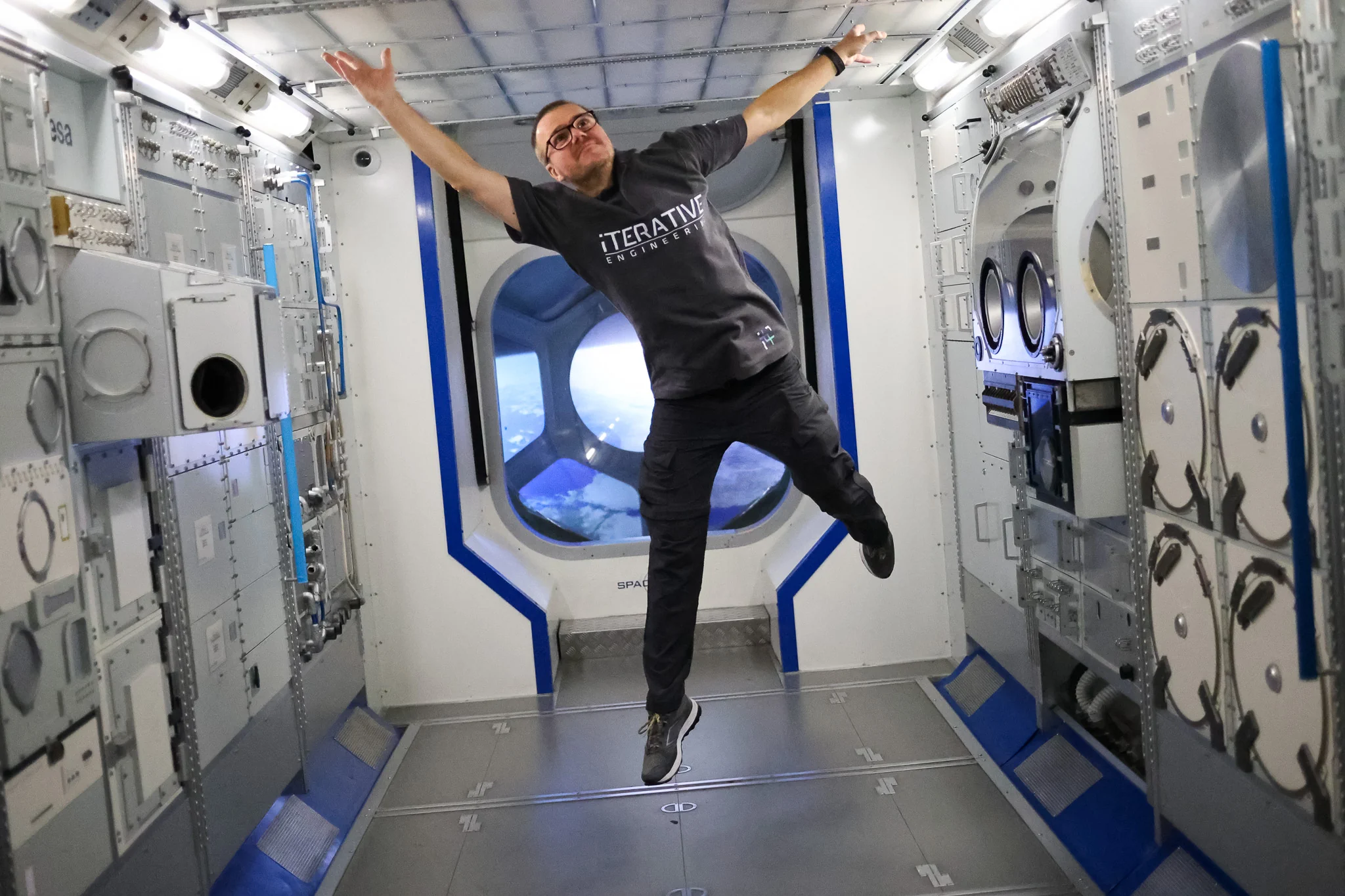
Attempting to recreate the feeling of weightlessness inside a full-scale mock-up of an International Space Station module at Space Expo. Unlike on the real ISS, gravity made this particular moment rather brief.
Photo: Paweł Grzywocz / Iterative Engineering.
On the ISS, objects do not stay on tables or floors simply because someone puts them there. Equipment must be secured, and astronauts use handrails, footholds, and other restraints to keep themselves in position while working.
The museum also includes some less obvious details of everyday life in orbit.
One example is an Orthodox icon displayed inside the mock-up of the Russian Zvezda module. This is not an arbitrary decorative addition. The presence of religious icons and other personal items aboard the actual Russian segment of the ISS has been documented in photographs taken in orbit.
A study published in Religions in 2020 examined how images of saints, religious symbols, flags, and photographs of historical figures appeared in the Zvezda module over time.
Such details reveal another side of the ISS. It is a sophisticated orbital laboratory, but it is also a temporary home where crew members bring elements of their personal lives and cultural traditions.
Spacelab and Wubbo Ockels: European Science Aboard an American Shuttle
Europe’s contribution to human spaceflight has not always involved developing its own crew transportation systems. It has also included scientific laboratories, instruments, and operational capabilities used in international missions.
One of the most important examples was Spacelab, a laboratory designed and built in Europe for use aboard NASA’s Space Shuttles.
At Space Expo, we photographed a transparent Shuttle model showing the laboratory installed inside the payload bay.
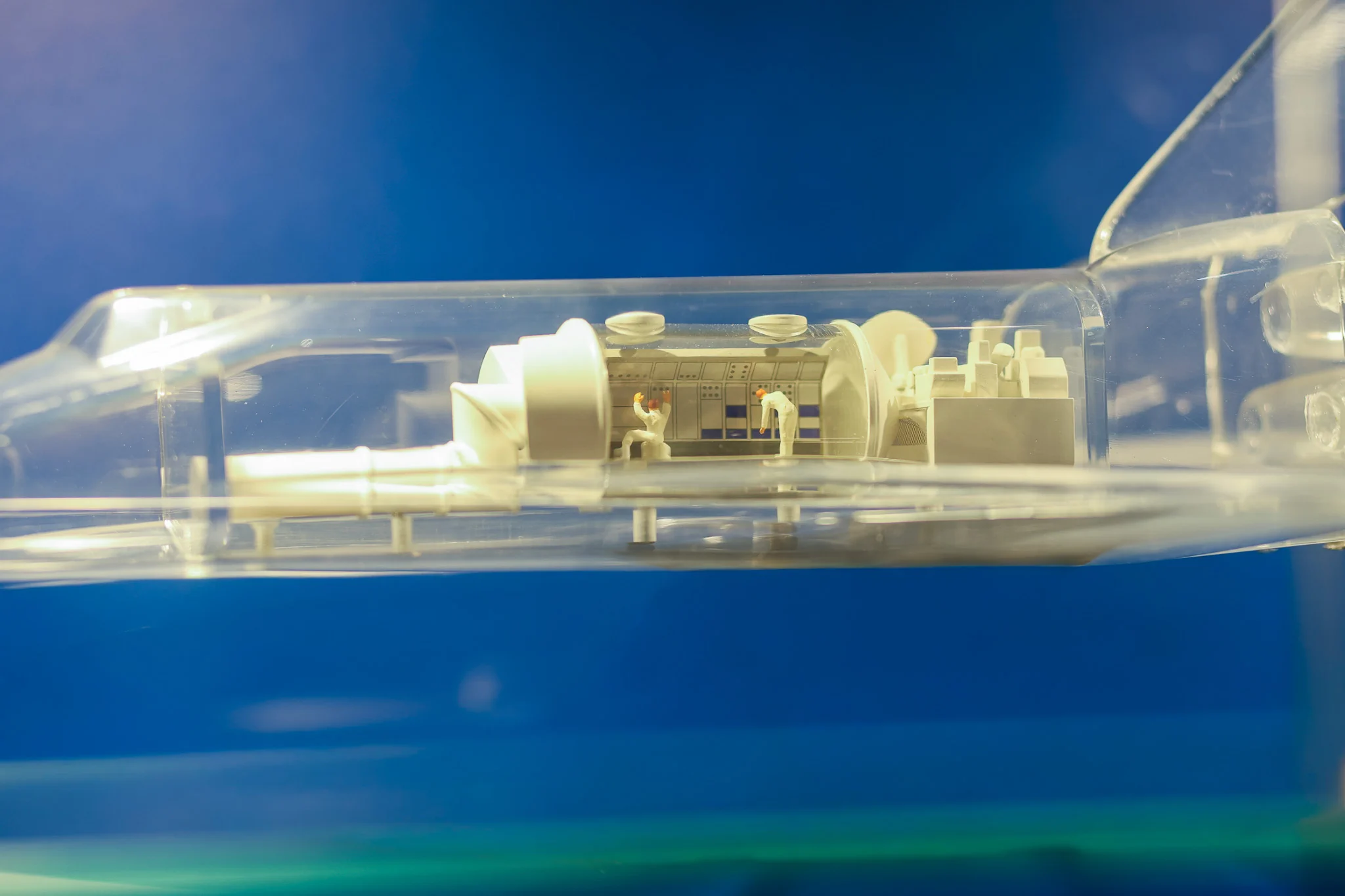
A transparent Space Shuttle model revealing Spacelab, the European-built laboratory carried in the Shuttle’s payload bay. Spacelab first flew aboard Columbia in November 1983, enabling scientists and astronauts to conduct experiments in orbit.
Photo: Tomasz Pac / Iterative Engineering.
Spacelab first flew aboard Columbia in November 1983. Among the crew was Ulf Merbold, the first ESA astronaut to travel into space.
Two years later, on 30 October 1985, Wubbo Ockels became the first Dutch citizen in space when he launched aboard Challenger on mission STS-61A.
Ockels worked as a payload specialist during the Spacelab D-1 mission, participating in scientific experiments conducted in orbit.
The mission was notable for another reason that receives less attention than the flight itself.
For the first time, the operation of an entire Shuttle payload was controlled from outside NASA’s mission control centres in the United States. Responsibility lay with the German Space Operations Centre in Oberpfaffenhofen, near Munich.
For Europe, this represented an important development. Participation in human spaceflight increasingly involved not only supplying scientific equipment but also taking responsibility for managing complex orbital operations.
Space Expo also commemorates Ockels through a dedicated exhibition featuring documents, personal belongings, and objects associated with his career.
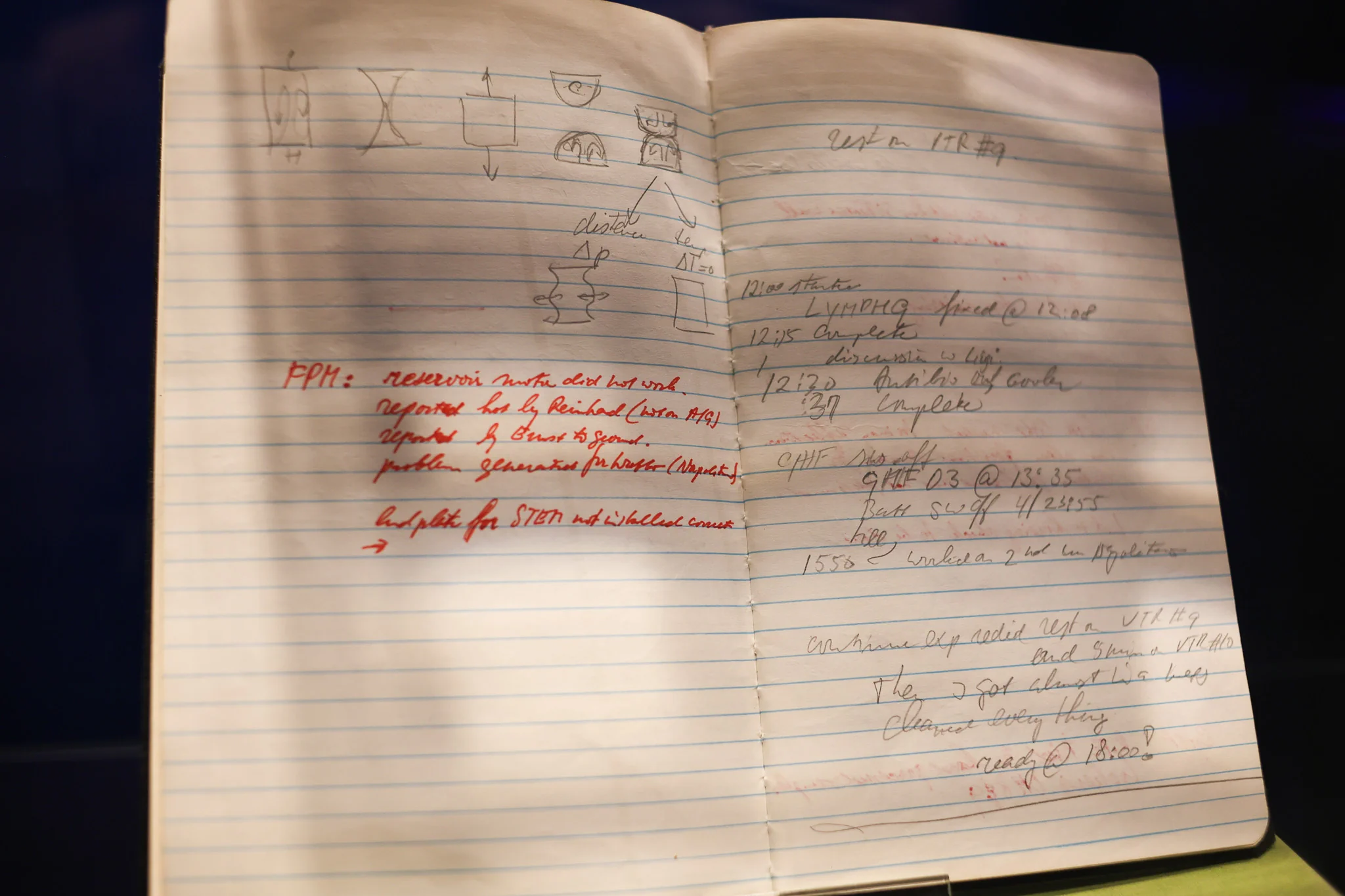
Handwritten notes displayed at Space Expo, offering a glimpse of the documentation and preparation associated with space exploration.
Photo: Tomasz Pac / Iterative Engineering.
These exhibits highlight a less visible aspect of space exploration: the preparation, documentation, experiments and everyday work that take place alongside the spacecraft and launch vehicles.
Resurs: When Satellite Images Had to Return to Earth
Today, satellite imagery is closely associated with digital sensors, data transmission and software used to process enormous volumes of information.
Only a few decades ago, however, some Earth observation systems worked very differently.
Space Expo displays an original Soviet Resurs F1-14F43 satellite, launched in 1988. The spacecraft spent approximately two weeks photographing Earth using conventional photographic film.
Five camera windows allowed its imaging instruments to observe the planet below. The photographs couldn’t be downloaded as digital files. The film had to return to Earth before it could be developed and analysed.
The spacecraft’s spherical return capsule was based on technology developed for Soviet Vostok and Zenit spacecraft.
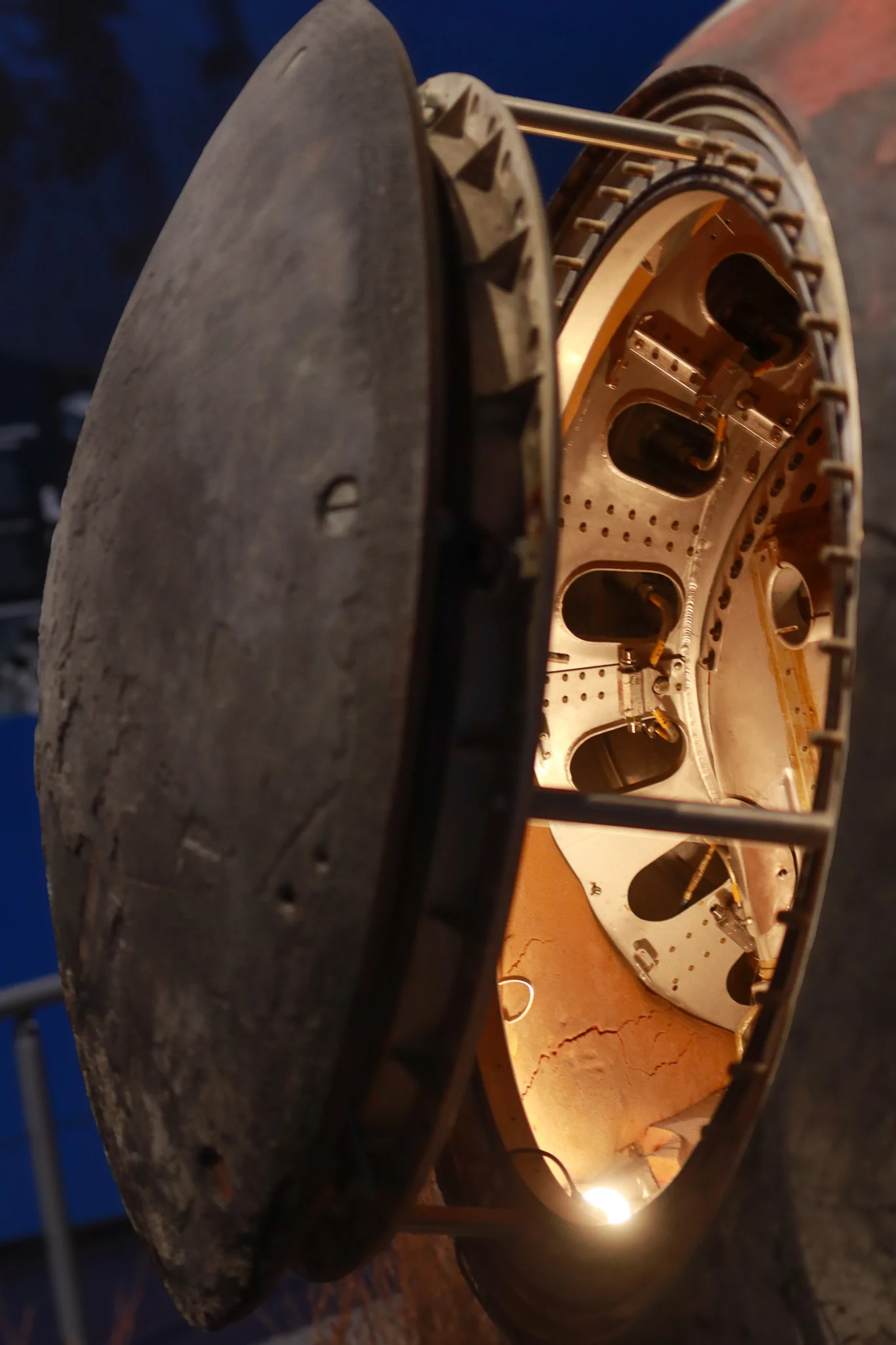
Open hatch and interior of the original Soviet Resurs F1-14F43 Earth observation satellite, flown in 1988. Unlike modern digital imaging satellites, Resurs recorded photographs on film that had to be returned to Earth for development and analysis.
Photo: Paweł Grzywocz / Iterative Engineering.
Looking inside this historical spacecraft offers a reminder of the physical limitations that once shaped satellite operations.
Recovering the images required much more than receiving a transmission. The spacecraft had to complete its mission, return its film to Earth, and survive atmospheric re-entry.
Modern Earth observation satellites can transmit data while remaining in orbit, often making imagery available shortly after it is collected.
The change goes well beyond replacing film with digital sensors. It has transformed how satellite information is collected, processed, distributed, and used in scientific research and operational applications.
Space Expo also looks towards technologies being developed for future exploration. Among its exhibits is ESA’s experimental Eurobot Ground Prototype, designed to investigate how robotic systems could support astronauts during missions to the Moon and Mars.
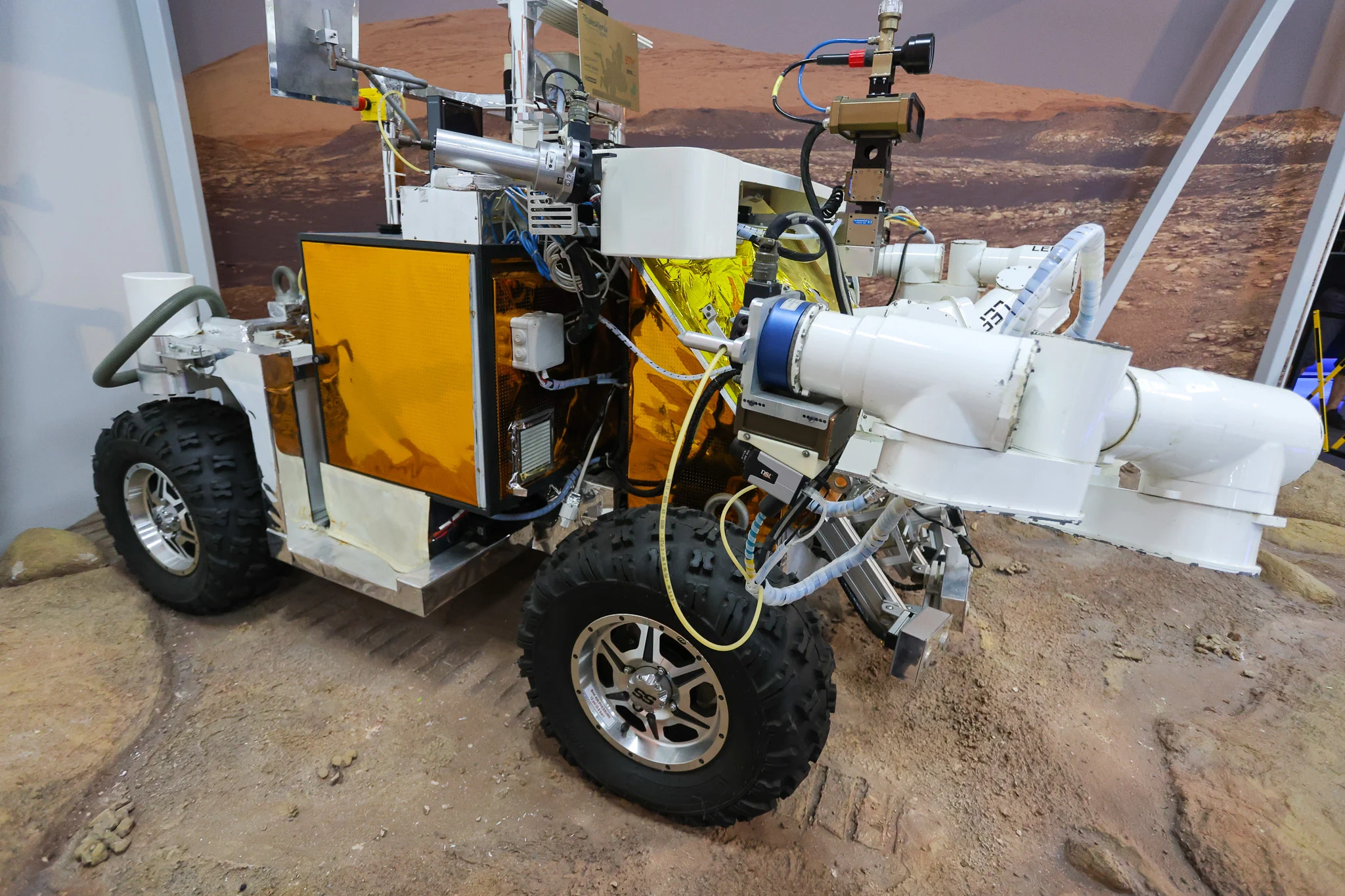
ESA’s Eurobot Ground Prototype, an experimental four-wheeled rover equipped with robotic arms. The project explored how robots could assist astronauts with tasks during future missions to the Moon and Mars.
Photo: Tomasz Pac / Iterative Engineering.
From film-return satellites to planetary rovers, the museum shows how spacecraft design has evolved in response to changing mission requirements, available technologies and operational needs.
Space History, Seen Up Close
Space Expo is more than a collection of objects from past missions. Many of its exhibits document technologies, engineering decisions and operational practices that shaped later developments in spaceflight.
Some approaches have changed almost beyond recognition. Others, such as the basic architecture of Soyuz, have proved remarkably durable.
The Ariane 4 consoles and the Spacelab story also show how European expertise developed beyond spacecraft hardware into the complex ground and orbital operations required to make missions work.
For us, the visit offered a historical perspective on some of the themes discussed during ESA Industry Space Days 2026. But it also provided something less directly related to our professional work: unusual details, personal objects, unexpected stories, and a Moon rock that brought a 1989 travel diary back into the conversation.
Space history is often told through launch dates, mission names, and technological milestones. At Space Expo, many of those stories become more tangible through the equipment and objects that remain.
Hero image: Full-scale recreation of the Apollo 11 Moon landing at Space Expo, featuring the Eagle lunar module and figures representing Neil Armstrong and Buzz Aldrin. The original Eagle landed on the Moon on 20 July 1969.
Photo: Tomasz Pac / Iterative Engineering.
- Apollo 11, a Moon Rock and a Memory from 1989
- Ariane: From Rocket Engines to Launch Operations
- Soyuz and the ISS: Space Technology Designed Around People
- Spacelab and Wubbo Ockels: European Science Aboard an American Shuttle
- Resurs: When Satellite Images Had to Return to Earth
- Space History, Seen Up Close